Nadif Guleed
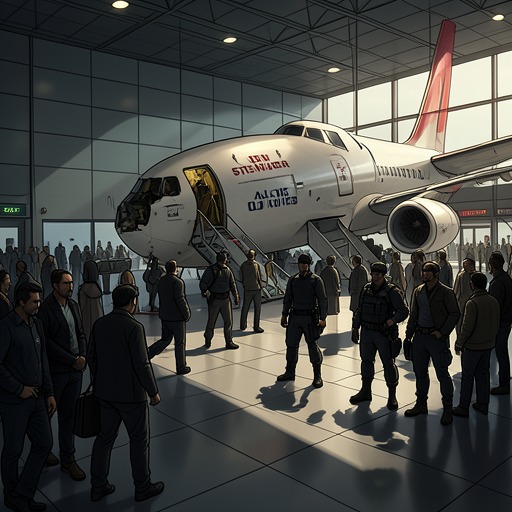
All the Old KnivesNadif Guleed is one of the four hijackers who seize Royal Jordanian Flight 127 after it lands in Vienna. Identified as Somali and a member of Aslim Taslam, he remains largely unnamed as an individual threat until the final confrontation: while trying to close the cockpit door, he is shot twice by Celia Favreau.
Identity and Place in the Hijacking
The Austrian authorities identify Guleed among the four men who took control of Flight 127, alongside Suleiman Wahed, Ibrahim Zahir, and Omar Ali. The aircraft, an Airbus 319 carrying 120 passengers and crew, had departed Amman and landed in Vienna without incident. The hijackers did not cause trouble during the flight; they stood up immediately after touchdown. Wahed shot a stewardess when she rose to direct him back to his seat. The account identifies that shooting as Wahed’s act, not Guleed’s.
Guleed is described as Somali and as a member of Aslim Taslam. The evidence supplies no personal history or individual account of his motives, and gives little detail of his actions during the earlier stages of the takeover. His place in the group is established through the authorities’ identification of the hijackers, rather than through a developed personal profile.
The Crisis Around Flight 127
The hijackers’ demand is for five prisoners—two held in Austria and three in Germany—to be released within forty-eight hours. Seventeen Americans are reported to be aboard, though that count is still being verified, and the hostages’ safety is set against the political difficulty of persuading the Austrian and German governments to comply. Owen Lassiter frames the choice starkly: the prisoners must be released, or everyone aboard will die; if the governments refuse, the plane may have to be stormed before the deadline.
The crisis is also unfolding in public. Television cameras from ORF are watching the plane from the airport fence. Celia points out that the hijackers called the media because they wanted eyes on the aircraft from outside. A forced retreat by reporters could itself prompt speculation that authorities were preparing an assault. Guleed is part of a hostage-taking operation in which the threat, the deadline, and the visibility of the plane all narrow the room for action, though the evidence does not assign him a separate role in setting those terms.
The Cockpit Confrontation
Guleed’s most specific action occurs during Celia’s attempt to protect her children, Evan and Ginny, from Wahed. As Wahed moves to seize them, Celia provokes him to buy time; when he pulls her into the aisle, Ginny’s scream becomes the cue for Celia to act. The narrative then shifts to the cockpit, where Guleed is desperately trying to close the door even though Omar Ali’s body is obstructing it.
Celia reaches the door, wrenches it open, steps into the cockpit, and shoots Guleed once in the face, then again. She is gasping and leans against the cockpit wall, confronted by the physical mess of death and by the silence that follows. The text presents Guleed’s shooting as part of Celia’s effort to protect her children and stop the remaining hijackers; it gives no further account of his condition or of what he does before trying to shut the door.
Narrative Significance
Guleed is drawn with few personal details, but his final action makes the cockpit threshold a point of irreversible change. His attempt to close the door meets Celia’s entry into the space and her immediate use of lethal force. The contrast between the hijacking’s public, political dimensions and this close, physical struggle turns a collective crisis into a stark individual encounter. Guleed’s characterization remains limited to his membership in the hijacker group and his position at that threshold; the decisive meaning of the scene lies in the violence Celia chooses in order to protect her children.